
 admin
admin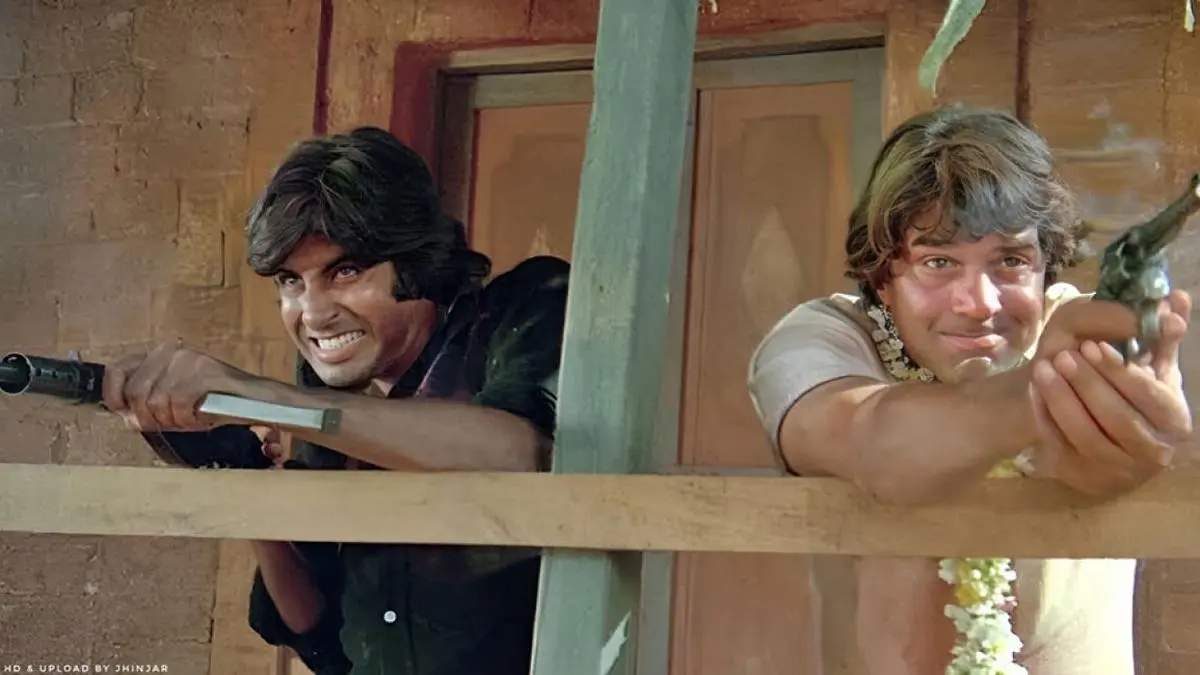
Actors Amitabh Bachchan and Dharmendra in a still from ‘Sholay’
Exactly fifty years ago, in 1975, I watched Sholay for the first time. I was a young school boy in Kollam in Kerala, where Hindi movies generally played second fiddle to Malayalam cinema. But the movie hall showing Sholay was packed to the brim for weeks together. At school, its dialogues became common currency. I fell under the spell of Gabbar Singh, Veeru, Jai and Basanti.
College days and ads
A few years later, I watched the movie again during my college days, at BITS Pilani. The story and the dialogues were as fresh and appealing as ever. Students banged chairs in the auditorium at the end of the show, to signal their great appreciation of this cult movie.
Then, again, when I joined Tata Tea as a young marketing manager, I discovered with pleasure that the launch advertising film for Tata Tea starred none other than Amjad Khan, who had played the role of the villain Gabbar Singh in Sholay. It was already the mid-1980s by now, but Gabbar Singh was as popular as ever. That advertisement was an amazing success.
Over the years, so many other brands have leveraged scenes, conversations and characters from Sholay for their television commercials, print advertisements, radio jingles and billboards. I distinctly recall Britannia using Gabbar Singh to promote its Glucose-D biscuits. Other brands that have hopped onto the Sholay bandwagon include ‘Amul’, ‘Mirinda’, ‘Tetley Tea’, ‘Whirlpool’, ‘McDonalds’, ‘Red Bull’, ‘Reliance’, ‘Orbit’ chewing gum and Swift pesticides.
Deep in our collective memory
In addition, the music from this movie keeps surfacing year after year, without fail. I have never seen a single Holi function where the song Holi ke din dil khil jaate hain, is not played. Mehbooba, Mehbooba was quite the anthem of my college days. Yeh Dosti, both the happy and the sad version, has kept cropping up quite regularly in my life, including at farewell events.
Somehow, Sholay has never really gone away from our collective memory. It has morphed from being just an iconic movie to becoming part of our lives. It has been described as a cultural milestone and a national allegory. How and why did this happen?
Storyline or characters?
Is it because of the powerful storyline, the battle between the greater good and pure evil, that lies at the core of this film? Is it because of multiple elements – revenge and violence, morality and criminality, humanity and emotion – that weave their way so seamlessly through the story?
Or is it because of the strong and diverse set of characters that walk through Sholay? The characters of Thakur Baldev Singh, Gabbar Singh, Veeru, Jai and Basanti are developed so well and so sharply that each of them gets embedded forever in our minds. Even Sambha, Gabbar Singh’s sidekick, is so memorable in his ever-so-brief appearances. Very few movies or works of literature bring to the fore so many appealing and likeable characters, so well fleshed out.
Star studded cast or dialogues?
Or could it be because the movie brought together a star-studded cast which included some of the best known names of Bollywood, including Sanjeev Kumar, Dharmendra, Hema Malini, Amitabh Bachchan, Jaya Bachchan and Amjad Khan?
Or, perhaps, was it the many, many memorable dialogues that made this film a cultural sensation? How can we forget lines such as – Tera kya hoga, Kaaliya? or Kitne aadmi the? or Tumhara naam kya hai, Basanti? or Arre oh Sambhaa! Kitna inaam rakha hai sarkar ne hum par?, all of which continue to live on in our hearts? So many of these lines continue to be used until today, which is truly amazing.
Or could it be the fact that this was the first Indian film to have a stereophonic soundtrack and to use the 70mm widescreen format, which made the movie so much larger than life? The title of the film itself was written so big and bold using cinemascope typography, making this point.
Impossible to say. Happy birthday!
As a marketer, I often take great pride in being able to pinpoint why a brand has succeeded or failed. But when I try to analyse the success of Sholay, I must admit defeat. There are so many elements that have gone into making this film successful, that it is virtually impossible to isolate one or two factors which have made this film such a roaring and lasting success. All I can say is that the combination of all these factors made magic happen, and it is impossible to analyse magic.
Sometimes, this is also true of the greatest of brands. They contain many thoughtfully designed and some accidental ingredients. But it is in the overall combination that the magic happens. Happy 50th birthday, Sholay !
Harish Bhat is an avid marketer and bestselling author. He was previously the Brand Custodian at Tata Sons.
Published on August 25, 2025
